
Lumber buyers face a difficult balancing act. Buy too much inventory, and valuable working capital becomes tied up in material that may lose value or age before it is sold. Buy too little, and product shortages, emergency purchases, and missed sales can quickly become expensive.
Add changing mill production, volatile prices, freight constraints, weather, and uneven regional demand, and the lowest quoted price does not always result in the lowest overall cost.
A knowledgeable wholesale lumber distributor helps buyers manage these variables. Through direct mill relationships, current market knowledge, disciplined inventory planning, and efficient freight coordination, a distributor can help customers make better purchasing decisions and reduce unnecessary supply chain costs.
At Frontier Forest Products, we call that Keeping Lumber Simple.
Direct Mill Relationships Improve Access and Visibility
Strong mill relationships are an important part of lumber distribution. They provide distributors with regular visibility into production levels, available tallies, shipping schedules, product mix, and changing mill needs.
These relationships do not eliminate price volatility. Lumber remains a commodity, and no supplier can control every market movement. However, direct and consistent communication with mills can give buyers more sourcing options and a clearer understanding of current supply conditions.
When mill production tightens or availability changes, an experienced distributor may identify those changes before they become obvious throughout the broader market. When mills have excess production or specific products that need to move, established relationships can also create purchasing opportunities.
The value is not simply gaining access to a mill price. It is understanding:
- Which mills have the right products available
- Whether the tally fits the customer’s actual needs
- When the material can realistically ship
- What freight will add to the delivered cost
- Whether the inventory can be sold within an acceptable period
- How the purchase fits the customer’s current inventory position
Frontier Forest Products works with mills throughout North America to provide Midwest lumber yards, retailers, and industrial buyers with dependable sourcing options. Our role is to evaluate those opportunities objectively and help customers determine whether they make sense for their businesses.
Market Knowledge Supports Better Purchasing Decisions
The lumber market can change quickly. Mill curtailments, housing activity, weather, transportation capacity, seasonal demand, and regional inventory levels can all affect price and availability.
Market knowledge does not mean predicting every price movement correctly. It means gathering information every day, recognizing changes, communicating clearly, and helping customers understand the risks and opportunities in front of them.
A knowledgeable wholesale lumber distributor sees activity from both sides of the supply chain. Mills provide information about production, availability, and shipping. Customers provide visibility into demand, inventory movement, and regional buying patterns.
Connecting those perspectives helps answer practical questions:
- Is supply becoming more limited?
- Are lead times getting longer?
- Is demand improving, weakening, or simply shifting?
- Is a lower mill price still attractive after freight?
- Should the buyer add inventory or allow current stock to turn?
- Is the product mix aligned with what customers are actually purchasing?
At Frontier Forest Products, we believe information should help customers make their own informed decisions. We communicate what we are seeing in the market without pretending that anyone can predict it with certainty.
That honest, objective approach helps buyers respond to changing conditions instead of reacting after an opportunity—or a problem—has already developed.
Freight Coordination Reduces Total Delivered Cost
Freight is a major part of the delivered cost of lumber. A favorable purchase at the mill can quickly become less attractive when transportation, handling, delays, and accessorial charges are included.
Effective freight management requires more than finding an available truck or railcar. It involves evaluating the product’s origin, destination, shipping method, volume, lead time, and unloading requirements.
A wholesale distributor can help coordinate:
- Truck and rail transportation
- Shipment scheduling
- Delivery appointments
- Carrier communication
- Order tracking
- Reload and transload options
- Direct shipments from mills
- Warehouse and inventory releases
The most efficient option is not always the same for every order. Direct shipments may reduce handling and storage costs for one customer, while warehouse availability may provide greater flexibility for another. Rail can be efficient for larger volumes, while truck transportation may provide faster or more precise delivery.
Frontier evaluates these options based on the customer’s needs and the total delivered cost—not simply the price at the point of origin.
Better freight coordination can reduce delays, unnecessary handling, emergency transportation costs, and the administrative burden of managing multiple suppliers and carriers.
Bridging the Gap Between Mill Production and Customer Demand
Mills are designed to manufacture lumber efficiently, often in large volumes and specific production runs. Lumber yards, retailers, and industrial users must purchase products according to local demand, available storage, customer needs, and inventory-turn expectations.
Those requirements do not always align.
A mill may have an attractive block of lumber available, but the volume or tally may not fit an individual buyer. A customer may need several products but lack the demand or storage capacity to purchase full mill quantities of each item.
The wholesale distributor helps bridge that gap.
Distributors purchase larger quantities, evaluate product mixes, maintain inventory, coordinate transportation, and make products available in quantities that better match customer demand. This allows customers to gain access to mill supply without taking on every risk associated with a full mill purchase.
The distributor also carries inventory risk. That makes disciplined buying just as important for the distributor as it is for the customer. Lumber has a financial shelf life. If it does not turn, it consumes working capital, adds storage expense, and becomes increasingly exposed to market movement.
At Frontier, inventory is not viewed simply as material sitting in a warehouse. It is capital that must be managed carefully and kept moving through the supply chain.
Inventory Turn Matters More Than Inventory Volume
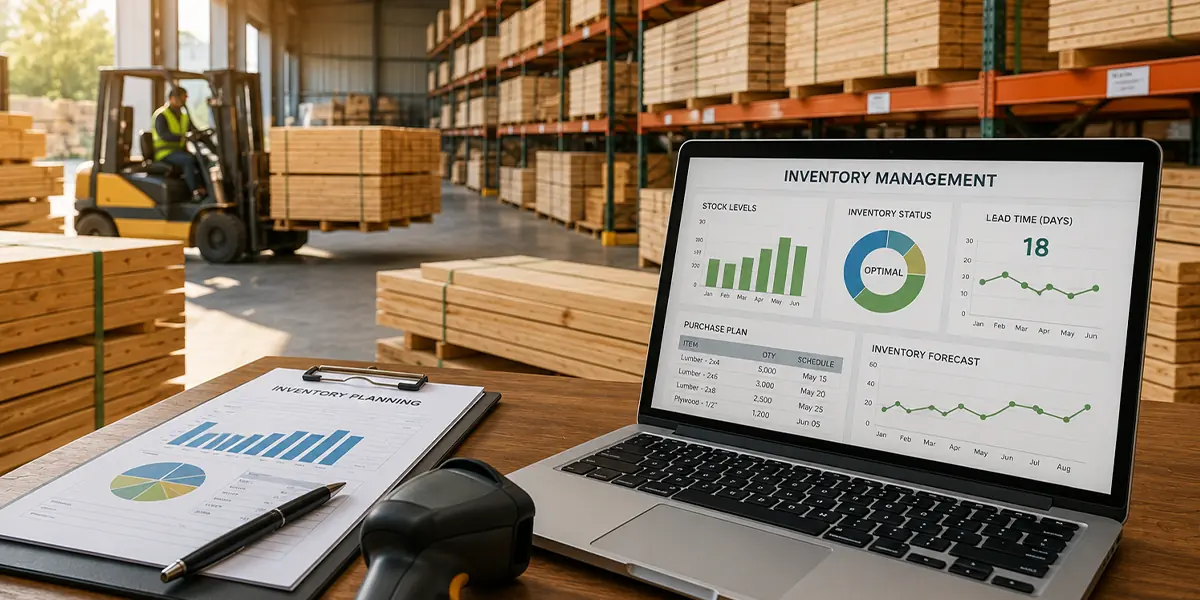
Having more inventory does not automatically create better service. The goal is to have the right inventory available at the right time.
Overstocking ties up cash, occupies valuable storage space, and increases exposure to declining markets. Understocking can lead to missed sales, emergency purchases, and inconsistent service. Both situations increase the customer’s true material cost.
An effective inventory strategy considers:
- Historical product movement
- Current and expected demand
- Available inventory
- Open purchase orders
- Lead times
- Seasonal buying patterns
- Product mix
- Market exposure
- Cost of carrying inventory
- Expected inventory turn
A distributor can help customers compare market opportunities against their actual needs. An inexpensive load is not truly inexpensive if the wrong products remain in inventory for six months.
Conversely, carrying additional inventory may be justified when supply is tightening, lead times are extending, or the customer has dependable demand for the product.
The objective is not to buy more or less. It is to buy smarter.
The Lowest Price Is Not Always the Lowest Cost
Purchase price is important, but it is only one part of the equation.
The total cost of lumber may also include:
- Freight
- Unloading and handling
- Storage
- Financing and working capital
- Aged or slow-moving inventory
- Product damage
- Emergency purchases
- Administrative time
- Missed sales caused by unavailable inventory
- Markdowns caused by poor inventory decisions
A slightly higher purchase price can sometimes produce a lower total cost when the product arrives reliably, matches customer demand, turns quickly, and requires less handling.
This is why Frontier focuses on the complete transaction. We consider the product, tally, freight, timing, inventory position, and expected turn—not simply the number printed on the invoice.
How Frontier Helps Midwest Buyers Source Smarter
Every customer has a different business model, inventory position, storage capacity, and tolerance for market risk. Effective distribution begins with understanding those differences.
Consider a Midwest lumber yard preparing for increased seasonal demand. The customer may need additional inventory, but purchasing too early or taking the wrong mix could create unnecessary exposure. Frontier can review available mill offerings, compare delivered costs, discuss current supply conditions, and coordinate deliveries that support the customer’s expected sales.
An industrial buyer may have consistent demand for specific dimensions but limited room to store large volumes. Frontier can help coordinate purchasing and delivery schedules that maintain availability while reducing the amount of capital tied up in inventory.
Another customer may find an attractive mill price but lack the volume, freight advantage, or product demand needed to justify a direct purchase. Frontier can evaluate the entire opportunity and provide an alternative that better fits the customer’s operation.
In each situation, the goal is the same: help the customer secure the right product, in the right quantity, from the right source, with an efficient delivery plan.
Choosing the Right Wholesale Lumber Distributor
The right distribution partner should offer more than a list of available products.
Buyers should look for a distributor that provides:
- Strong and diverse mill relationships
- Current knowledge of lumber-market conditions
- Honest and consistent communication
- Reliable truck and rail coordination
- Regional inventory and distribution capabilities
- An understanding of inventory turn and working capital
- Objective recommendations based on the customer’s needs
- Dependable service before, during, and after the sale
A trusted distributor should be willing to tell a customer when an opportunity makes sense—and when it does not.
That level of objectivity builds better long-term relationships and helps both companies operate more efficiently.
Better Decisions Create a Better Supply Chain
Supply chain efficiency is not created by chasing the lowest price on every purchase. It comes from making disciplined decisions across sourcing, freight, inventory, timing, and communication.
No wholesale lumber distributor can eliminate commodity-market volatility. The right distributor can help customers navigate it with better information, more sourcing options, efficient logistics, and a clearer understanding of total cost.
Frontier Forest Products helps Midwest lumber yards, retailers, and industrial buyers manage inventory, evaluate purchasing opportunities, coordinate freight, and maintain access to the products their customers need.
By connecting mill production with regional demand, Frontier helps customers reduce unnecessary costs, improve inventory movement, and make purchasing decisions with greater confidence.
That is how we work to keep lumber simple.
